The Essential Keynes by John Maynard Keynes
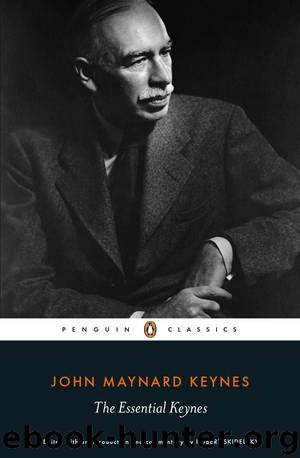
Author:John Maynard Keynes
Language: eng
Format: epub, mobi
Publisher: Penguin Publishing Group
Published: 2015-04-06T04:00:00+00:00
II
There is, however, a second, much more fundamental inference [374] from our argument which has a bearing on the future of inequalities of wealth; namely, our theory of the rate of interest. The justification for a moderately high rate of interest has been found hitherto in the necessity of providing a sufficient inducement to save. But we have shown that the extent of effective saving is necessarily determined by the scale of investment and that the scale of investment is promoted by a low rate of interest, provided that we do not attempt to stimulate it in this way beyond the point which corresponds to full employment. Thus it is to our best advantage to reduce the rate of interest to that point relatively to the schedule of the marginal efficiency of capital at which there is full employment.
There can be no doubt that this criterion will lead to a much lower rate of interest than has ruled hitherto; and, so far as one can guess at the schedules of the marginal efficiency of capital corresponding to increasing amounts of capital, the rate of interest is likely to fall steadily, if it should be practicable to maintain conditions of more or less continuous full employment – unless, indeed, there is an excessive change in the aggregate propensity to consume (including the State).
I feel sure that the demand for capital is strictly limited in the sense that it would not be difficult to increase the stock of capital up to a point where its marginal efficiency had fallen to a very low figure. This would not mean that the use of capital instruments would cost almost nothing, but only that the return from them would have to cover little more than their exhaustion by wastage and obsolescence together with some margin to cover risk and the exercise of skill and judgment. In short, the aggregate return from durable goods in the course of their life would, as in the case of short-lived goods, just cover their labour costs of production plus an allowance for risk and the costs of skill and supervision.
Now, though this state of affairs would be quite compatible [375] with some measure of individualism, yet it would mean the euthanasia of the rentier, and, consequently, the euthanasia of the cumulative oppressive power of the capitalist to exploit the scarcity-value of capital. Interest to-day rewards no genuine sacrifice, any more than does the rent of land. The owner of capital can obtain interest because capital is scarce, just as the owner of land can obtain rent because land is scarce. But whilst there may be intrinsic reasons for the scarcity of land, there are no intrinsic reasons for the scarcity of capital. An intrinsic reason for such scarcity, in the sense of a genuine sacrifice which could only be called forth by the offer of a reward in the shape of interest, would not exist, in the long run, except in the event of the individual propensity to consume
Download
This site does not store any files on its server. We only index and link to content provided by other sites. Please contact the content providers to delete copyright contents if any and email us, we'll remove relevant links or contents immediately.
| Anthropology | Archaeology |
| Philosophy | Politics & Government |
| Social Sciences | Sociology |
| Women's Studies |
The remains of the day by Kazuo Ishiguro(8997)
Tools of Titans by Timothy Ferriss(8393)
Giovanni's Room by James Baldwin(7345)
The Black Swan by Nassim Nicholas Taleb(7128)
Inner Engineering: A Yogi's Guide to Joy by Sadhguru(6792)
The Way of Zen by Alan W. Watts(6614)
The Power of Now: A Guide to Spiritual Enlightenment by Eckhart Tolle(5781)
Asking the Right Questions: A Guide to Critical Thinking by M. Neil Browne & Stuart M. Keeley(5772)
The Six Wives Of Henry VIII (WOMEN IN HISTORY) by Fraser Antonia(5514)
Astrophysics for People in a Hurry by Neil DeGrasse Tyson(5189)
Housekeeping by Marilynne Robinson(4445)
12 Rules for Life by Jordan B. Peterson(4303)
Ikigai by Héctor García & Francesc Miralles(4273)
Double Down (Diary of a Wimpy Kid Book 11) by Jeff Kinney(4268)
The Ethical Slut by Janet W. Hardy(4251)
Skin in the Game by Nassim Nicholas Taleb(4248)
The Art of Happiness by The Dalai Lama(4130)
Skin in the Game: Hidden Asymmetries in Daily Life by Nassim Nicholas Taleb(4004)
Walking by Henry David Thoreau(3960)
